Sauces

How Leading Sauce Manufacturers Build Agile Production Lines?

Factories want to be capable of introducing a new product next week, changing bottle formats tomorrow, switching recipes this afternoon and maintaining filling accuracy throughout all without sacrificing food safety or profitability. Discover in this article the Five Pillars of Manufacturing Flexibility

Many food manufacturers discover too late that flexibility cannot simply be “added” to an existing production line. It must be engineered from the very beginning. Historically, filling equipment was designed around a single objective: maximum throughput. The assumption was simple. Produce one product or two. Use two or three bottles. Run for several days. Repeat.

That philosophy made perfect sense twenty years ago. Today, however, it no longer reflects reality.

Sauce manufacturers can produce:

  • 150 g squeeze bottles
  • 250 g glass jars
  • 500 g PET bottles
  • Organic recipes
  • Vegan formulations
  • Chunky sauces
  • Smooth emulsions
  • Premium products
  • Retail formats


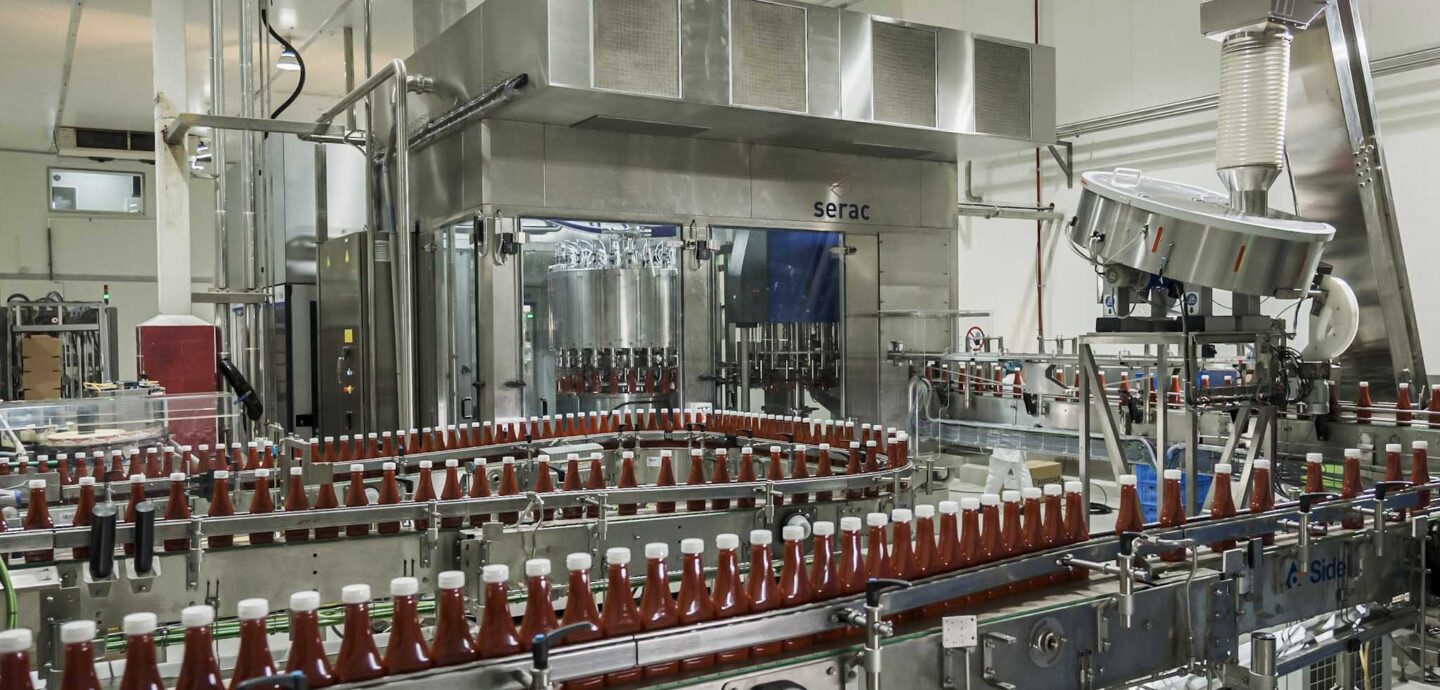
all on the same production line. The objective has therefore changed. Instead of maximizing production speed, manufacturers increasingly seek to maximize productive time.

Flexibility & SKU Expansion in Sauce Manufacturing
How Leading Sauce Manufacturers Build Agile Production Lines?

Key Takeaways
1 Flexibility must be engineered into the production line not added later.
2 Fast changeovers often generate greater productivity gains than higher filling speeds.
3 Multi-viscosity capability is essential for modern sauce portfolios.
4 Instead of manually adjusting the equipment for each product, operators simply select each recipe on the screen to configure the machine.
5 Hygienic design enables rapid product transitions while protecting food safety.

The Five Pillars of Manufacturing Flexibility

From our experience across the food industry, flexibility can be divided into five engineering pillars. Factories that perform well in all five areas consistently achieve shorter changeovers, higher OEE and lower operating costs.

  • 1- Fast Changeovers

    Every minute spent changing products is a minute when the factory generates no revenue.This makes changeover time one of the most expensive “hidden costs” in manufacturing.

  • 2- Multi-Viscosity Filling

    Designing one filling system capable of handling different type of sauces requires much more than increasing pump power.

  • 3- Multi-Format Packaging

    Leading producers seek equipment capable of accommodating a broad range of containers with minimal adjustment.

  • 4- Recipe Management

    Instead of manually adjusting the equipment for each product, operators simply select each recipe on the screen to configure the machine.

  • 5- Hygienic Design

    As product portfolios expand, cleaning becomes increasingly important.

1- Fast Changeovers

Every minute spent changing products is a minute when the factory generates no revenue. This makes changeover time one of the most expensive “hidden costs” in manufacturing. Yet many plants still accept long changeovers as unavoidable.

The most efficient manufacturers think differently.

Instead of asking:

“How long does a changeover take?”

they ask:

Why does it take this long?”

The answer often reveals opportunities for improvement.


Typical causes include:

  • manual mechanical adjustments
  • multiple tools
  • operator-dependent settings
  • lengthy cleaning sequences
  • manual documentation
  • repeated quality checks


Modern filling systems reduce these delays through:

  • servo-controlled adjustments
  • automatic positioning
  • stored production recipes
  • digital parameter recall
  • quick-release components
  • tool-less format changes


The result is not only shorter changeovers but also greater repeatability. Operators spend less time adjusting equipment and more time producing saleable products.


Applying SMED Principles to Sauce Manufacturing

One of the most effective methodologies for reducing changeover time is SMED (Single-Minute Exchange of Dies), originally developed by Shigeo Shingo for the automotive industry.

Although conceived for stamping presses, the principles translate remarkably well to food manufacturing.

SMED encourages manufacturers to:

  • separate internal and external activities
  • prepare the next product before production stops
  • standardize adjustments
  • eliminate unnecessary movements
  • simplify operator tasks


For a sauce producer, this might involve:

  • Preparing bottles before the current batch finishes.
  • Pre-loading recipes into the HMI.
  • Organising caps and labels in advance.
  • Using colour-coded change parts.
  • Reducing operator intervention.


Each improvement may save only a few minutes. Across hundreds of changeovers each year, however, the cumulative gain becomes substantial.

2- Multi-Viscosity Filling

Few food categories exhibit as much viscosity variation as sauces.

Consider the difference between:

  • Soy sauce
  • Mayonnaise
  • Pesto
  • Honey mustard
  • Tomato ketchup
  • Hummus
  • Chunky salsa


Each behaves differently inside the filling system. Some products flow freely. Others contain herbs, seeds or vegetable pieces.Some foam easily. Others trap air. Some become significantly thicker as temperature changes.

Designing one filling system capable of handling a lot of type of sauces requires much more than increasing pump power.

It requires:

  • stable product flow
  • accurate metering
  • gentle handling
  • consistent pressure control
  • minimal shear
  • repeatable dosing


The wider the viscosity range, the greater the engineering challenge.


Product Behaviour Matters More Than Product Name

Manufacturers often classify products by commercial category. Engineers classify them by behaviour. Two products may both be labelled “barbecue sauce.” One may behave like ketchup. The other may resemble a chunky marinade.

Similarly, two mayonnaise recipes may exhibit completely different rheological properties because of oil content, stabilisers or temperature.

Successful flexible production lines therefore adapt to product behaviour rather than product category.

3- Multi-Format Packaging

Consumers increasingly expect packaging options that match different occasions. A single recipe may be marketed in:

  • 250 g squeeze bottle
  • 450 g PET bottle
  • 500 g glass bottle
  • 1 L family bottle
  • 5 L foodservice container
  • Export packaging
  • Retail packaging
  • Promotional packaging


Each format introduces new challenges.

  • Bottle height
  • Bottle diameter
  • Neck diameter
  • Closure type
  • Label position
  • Carton dimensions


Without a flexible filling line, manufacturers may require separate equipment for each format. That approach quickly becomes expensive. Instead, leading producers seek equipment capable of accommodating a broad range of containers with minimal adjustment.


Why Packaging Standardisation Matters?

An often-overlooked strategy involves reducing unnecessary packaging complexity. Many manufacturers unintentionally create dozens of unique bottle and cap combinations. Standardising certain components can dramatically simplify production.

Examples include:

  • Using identical neck diameters across several bottles.
  • Sharing cap families.
  • Reducing label dimensions.
  • Using modular bottle designs.


Packaging decisions therefore influence manufacturing flexibility long before production begins.

4- Digital Recipe Management

The most advanced factories increasingly rely on digital production recipes. Instead of manually adjusting equipment for each product, operators simply select: “Ketchup 500 g.”

The system automatically recalls:

  • Filling volume.
  • Pump speed.
  • Pressure.
  • Nozzle position.
  • Container height.
  • Cap torque.
  • Reject limits.
  • Quality parameters.


Digitalisation Supports Consistency

One of the greatest advantages of recipe management is repeatability. Without stored recipes, two operators may configure the same product differently. With digital recipes, the machine reproduces identical settings every time. Consistency becomes independent of operator experience. This is particularly valuable for manufacturers operating multiple production shifts or multiple factories.

5- Hygienic Design

Flexibility must never compromise food safety. As product portfolios expand, cleaning becomes increasingly important.

Especially with:

  • Clean Label products.
  • Organic sauces.
  • Egg-based emulsions.
  • High-oil formulations.
  • Allergen-containing recipes.


Frequent product changes increase cleaning frequency.Poor hygienic design therefore has a direct effect on productivity.

hygienic engineering seeks to minimise:

  • dead zones
  • product retention
  • manual cleaning
  • water consumption
  • chemical usage
  • downtime


The objective is simple:  Clean faster. Clean better. Return to production sooner.

The factories that will lead the next decade of sauce manufacturing are unlikely to be those with the highest filling speeds.

Instead, they will be the factories capable of introducing a new product next week, changing bottle formats tomorrow, switching recipes this afternoon and maintaining filling accuracy throughout all without sacrificing food safety or profitability.

Flexibility is no longer simply an engineering objective. It has become a strategic business capability.  The manufacturers that master it will respond faster to retailers, launch products more quickly and adapt more effectively to changing consumer expectations.

Build a More Flexible Sauce Production Line

Your product portfolio is evolving. Your production line should be ready for it.

From multi-viscosity sauces and products with particulates to multiple packaging formats and frequent SKU changes, Serac designs filling solutions engineered for flexibility, efficiency and long-term growth.

Ready to make your sauce production line more agile?

Contact our experts to explore the right filling solution for your products, formats and production requirements.

Frequently Asked Questions


What is flexibility in sauce manufacturing?

Flexibility in sauce manufacturing is the ability of a production line to efficiently handle different sauce recipes, viscosities, packaging formats and production volumes with minimal downtime and changeover time. A flexible line combines adaptable filling equipment, fast format changes, digital recipe management and hygienic design to support a growing number of SKUs.


How can sauce manufacturers reduce changeover time?

Sauce manufacturers can reduce changeover time by using servo-controlled adjustments, stored production recipes, quick-release components, tool-less format changes and automated positioning. Applying SMED principles can also help separate tasks that can be performed while the line is running from those that require the equipment to be stopped.


How can one filling machine handle sauces with different viscosities and particulates?

A flexible sauce filling system must be engineered around product behavior rather than simply the product name. Different sauces may require controlled product flow, accurate metering, pressure management, gentle product handling and appropriate filling technology. Products containing particulates, such as herbs or vegetable pieces, require additional consideration to ensure consistent dosing without damaging the product.


Why is multi-format packaging important for sauce manufacturers?

Multi-format packaging allows manufacturers to produce different bottle and container sizes on the same production line. Flexible equipment can accommodate variations in container height, diameter, neck finish and closure type while minimizing mechanical adjustments. This helps manufacturers expand their product portfolio without investing in dedicated equipment for every SKU.


How does digital recipe management improve sauce production flexibility?

Digital recipe management allows operators to recall predefined production parameters for each product and packaging format. Parameters such as filling volume, pump speed, pressure and equipment positioning can be automatically restored, reducing manual adjustments, operator dependency and setup errors. It also improves production repeatability and traceability across shifts and production sites.

The following articles may interest you