

Why Increasing Sauces Variety Can Reduce Profitability?
One of the greatest paradoxes of the modern agri-food industry is that the very strategy designed to drive a company's growth can, in the long run, undermine its profitability. Here's why.
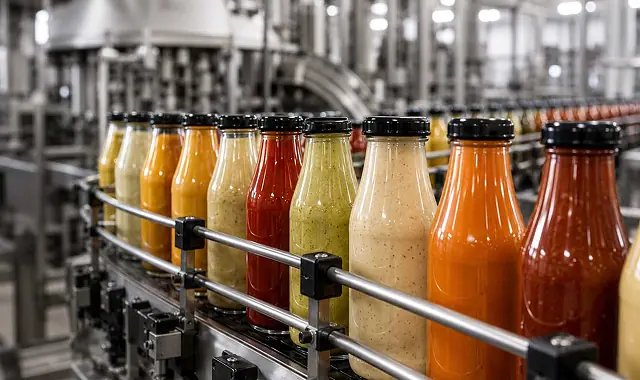
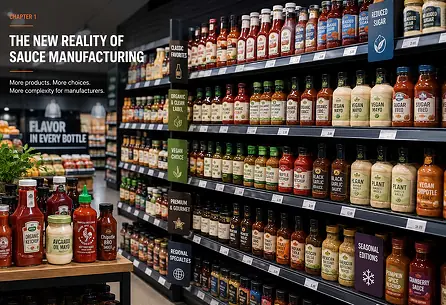
Launching new products is generally perceived as a positive achievement. Every additional SKU represents an opportunity to address a new consumer segment, strengthen relationships with retailers, differentiate the brand from competitors or enter a new market.
Yet behind every successful product launch lies an operational consequence that is often underestimated.
Taken individually, these changes appear relatively minor. Collectively, however, they fundamentally transform the way a factory operates. For many manufacturers, the financial consequences of this transformation remain largely invisible because they are distributed across several departments rather than appearing as one clearly identifiable production cost.
Unlike raw materials or labour, complexity rarely has its own line within the annual budget. Instead, it gradually affects almost every operational indicator that determines industrial performance.
These individual effects may appear insignificant when viewed separately. Together, however, they often represent one of the largest hidden costs within modern food manufacturing.
Flexibility & SKU Expansion in Sauce Manufacturing
Why Increasing Product Variety Can Quietly Reduce Profitability?
| Key Takeaways | |
| 1 | Product variety drives growth but also hidden costs. Every new SKU creates commercial opportunities, but it also adds operational complexity that can quietly reduce manufacturing profitability |
| 2 | Complexity grows exponentially, not linearly. Managing 100 SKUs is far more than ten times harder than managing 10. More recipes, packaging formats, and production scenarios create increasingly complex interactions across planning, quality, maintenance, and warehouse operations. |
| 3 | Changeovers are one of the biggest hidden productivity losses. Every product transition stops production for cleaning, equipment adjustments, validation, and restart procedures. Reducing changeover time often delivers a greater financial return than increasing maximum filling speed. |
| 4 | Cleaning is now a strategic productivity factor. Frequent recipe changes require more cleaning cycles, consuming water, energy, detergents, labor, production time, and generating product losses. As batch sizes shrink, cleaning becomes an increasingly significant operational cost. |
Many manufacturers assume that doubling the number of SKUs will simply double the complexity of production. Unfortunately, manufacturing rarely behaves in such a predictable manner. Complexity tends to grow exponentially.
A factory producing ten products can usually organize its production schedule relatively easily. Operators become familiar with each recipe, production planners optimize manufacturing campaigns, and maintenance teams understand the equipment requirements associated with each product.
As the product portfolio expands to fifty, one hundred or even several hundred SKUs, the situation changes dramatically. Production planners must coordinate a far greater number of recipes while balancing customer priorities, raw material availability and packaging inventories. Quality departments must validate more product transitions and verify additional production parameters. Maintenance teams must support increasingly complex equipment adjustments. Warehouse personnel must manage larger inventories of bottles, caps, labels and cartons. Operators must learn an expanding number of production recipes and machine settings.
The result is a manufacturing environment that becomes progressively more difficult to control. Rather than adding ten percent more work, every additional SKU introduces new interactions between products, packaging formats, production schedules and operational procedures.
This phenomenon explains why many factories begin to experience declining productivity long before production capacity has actually been reached.
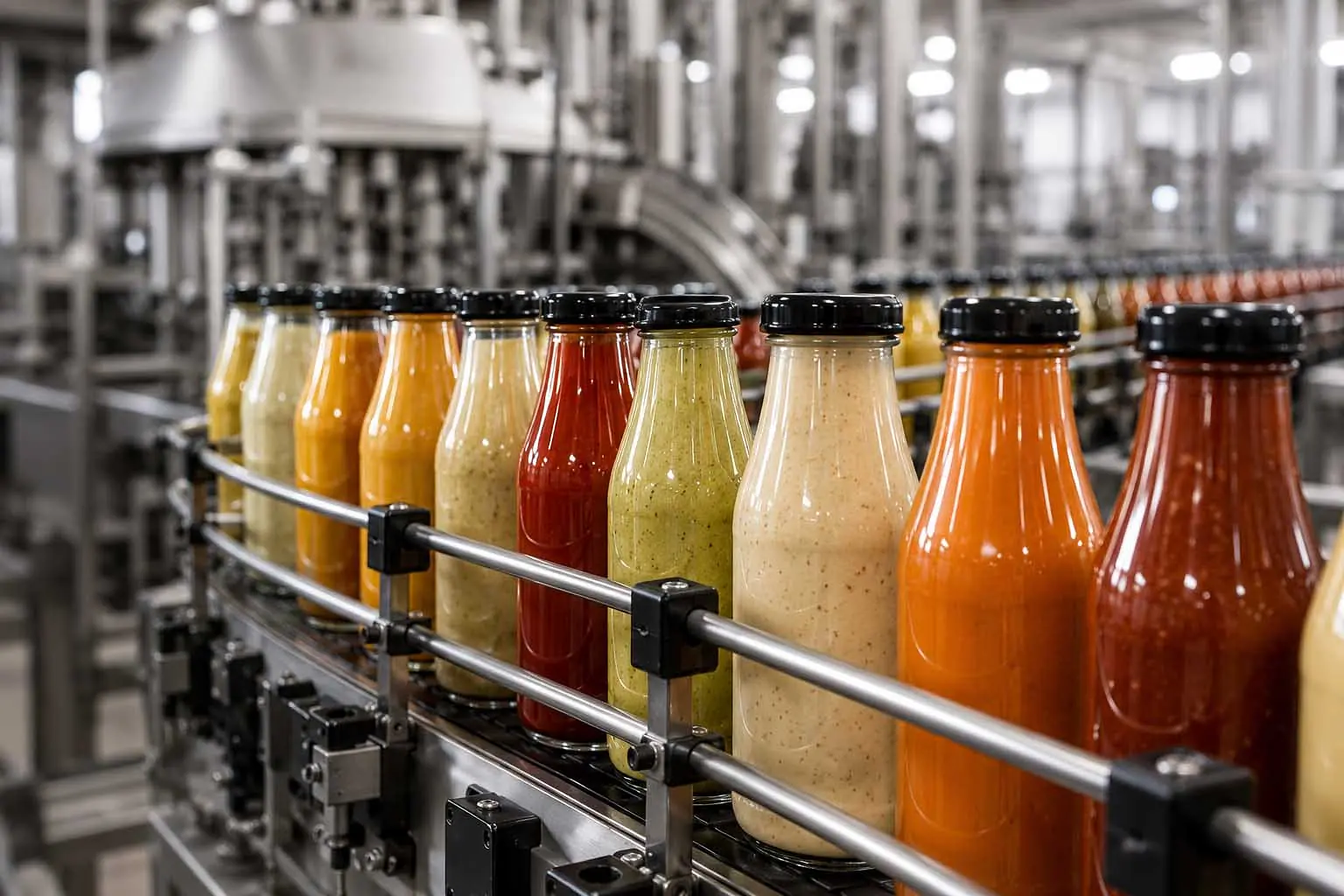
Among all the hidden consequences of SKU proliferation, changeovers probably represent the most visible and the least appreciated. Whenever production switches from one sauce to another, the filling line must stop producing.
At that moment, the factory is no longer generating revenue. Operators empty product circuits, perform cleaning procedures, replace change parts, adjust filling parameters, prepare new packaging components, validate the first containers and progressively restart production.
Every one of these activities is essential for maintaining product quality and food safety. None of them, however, generates saleable products.
This distinction is extremely important. Manufacturing profitability depends not only on how quickly equipment produces bottles but also on how many hours per year the equipment actually spends producing.
Many factories proudly report maximum filling speeds exceeding twenty thousand bottles per hour while overlooking the fact that several hundred hours every year are lost during product transitions.
For manufacturers managing dozens or even hundreds of SKUs, reducing changeover duration often creates a greater financial benefit than increasing maximum machine speed.
Recovering thirty minutes during every product change may appear modest. Across several hundred annual changeovers, however, these savings accumulate into hundreds of productive hours that can be converted directly into additional production capacity.
Few food categories present such diverse processing conditions as sauces. A ketchup recipe behaves very differently from mayonnaise. Pesto containing herbs and particulates behaves differently from a smooth salad dressing. Hot sauces frequently contain spices and oils that require specific cleaning procedures. Products containing allergens introduce additional hygienic requirements.
Every transition between these products requires an appropriate cleaning process to ensure product integrity and food safety. Cleaning therefore represents much more than a maintenance activity. It is an integral part of production.
Unfortunately, cleaning also consumes valuable manufacturing resources.
Furthermore, every cleaning cycle generates additional product losses because valuable sauce remains inside tanks, pipelines, pumps and filling valves at the end of production.
These losses are rarely measured with the same attention as filling giveaway, yet they often represent a significant source of avoidable waste. As production campaigns become shorter, cleaning frequency naturally increases, amplifying its impact on overall factory performance.
The operational consequences of SKU proliferation extend well beyond the production floor. Every new product requires additional packaging materials, additional ingredients and additional inventory management.
A manufacturer introducing ten new sauce recipes may also need to manage:
Inventory carrying costs increase. Forecasting becomes more complicated. Procurement activities multiply. The probability of obsolete packaging materials also rises as product portfolios continue expanding. Many manufacturers focus primarily on production efficiency while overlooking the financial implications of increased inventory complexity. Yet capital invested in slow-moving packaging components represents money that cannot be invested elsewhere within the business.
Improving manufacturing flexibility therefore contributes not only to production efficiency but also to healthier inventory management and stronger financial performance.
Overall Equipment Effectiveness remains one of the most widely used indicators of manufacturing performance. By combining availability, performance and quality, OEE provides a comprehensive measure of production efficiency. SKU proliferation influences all three components simultaneously.
Consequently, a growing number of SKUs naturally exerts downward pressure on OEE. Many manufacturers respond by attempting to increase production speed.
In reality, improving flexibility often produces greater improvements because it addresses the root causes of lost productive time rather than simply accelerating production once it has already started.
One of the defining characteristics of today’s sauce industry is the gradual reduction in production batch size.
Retailers increasingly request smaller quantities delivered more frequently. Limited editions reduce campaign duration. Seasonal promotions shorten production schedules. Private-label contracts introduce numerous customer-specific variations.
As production campaigns become shorter, the fixed activities surrounding each batch occupy an increasingly large proportion of total manufacturing time. Planning remains necessary regardless of batch size. Cleaning, quality validation, machine adjustment and documentation remain necessary.
Consequently, manufacturing costs per bottle increase even when annual production volume remains unchanged. Factories capable of reducing these fixed activities through greater flexibility are therefore significantly better positioned to maintain profitability while supporting increasingly diverse product portfolios.
Is Your Product Portfolio Creating Hidden Production Costs?
Discover how the right filling technology can help you manage different sauces, viscosities, particulates and product formats while minimizing changeover time and production losses.
Contact us to discuss your sauce filling requirements and identify the right solution for your production.
Why Increasing Sauces Variety Can Reduce Profitability?
Frequently Asked Questions
A flexible filling line should be able to handle multiple recipes, viscosities, container formats, and closures with minimal downtime between production runs. Flexibility goes beyond accommodating different bottle sizes. It includes fast changeovers, multi-viscosity filling capability, digital recipe management, hygienic design, and equipment that can evolve as the manufacturer’s product portfolio expands.
A filling system designed for a diverse sauce portfolio must adapt to the actual behavior of each product rather than simply its product category. Smooth ketchup, mayonnaise, pesto, chunky salsa, and fluid dressings can behave very differently during filling. The equipment therefore needs to provide accurate metering, stable product flow, gentle product handling, controlled pressure, and repeatable dosing across different viscosities and products containing particulates.
Changeover time can be reduced by minimizing manual operations and preparing as many activities as possible before the current production run stops. Solutions can include stored production recipes, servo-controlled adjustments, automatic positioning, quick-release components, tool-less format changes, and SMED principles. Preparing bottles, caps, labels, and machine recipes in advance can further reduce non-productive time between SKUs.
Digital recipe management allows operators to recall predefined machine settings for each SKU instead of manually configuring the equipment at every product change. Parameters such as filling volume, pump speed, pressure, nozzle position, container height, cap torque, and reject limits can be stored and recalled. This helps shorten setup times, reduce operator errors, improve repeatability, and strengthen production traceability, particularly across multiple shifts or production sites.
Manufacturers should evaluate flexibility based on both their current portfolio and the products they may need to produce in the future. Key considerations include the range of sauce viscosities and particulates, container and closure formats, cleaning requirements, changeover frequency, recipe management, and the ability to add or modify equipment modules. A modular and hygienically designed production line can make it easier to introduce new SKUs while limiting additional capital investment, downtime, and operational complexity.
Dominique Ledru
Communication Manager
Dominique Ledru is a Marketing & Communications expert at Serac, with extensive experience in the packaging industry. Passionate about innovation and emerging trends, he explores how new technologies, sustainability, and evolving market expectations are shaping the future of packaging. Through his articles, Dominique shares insights and perspectives drawn from his experience at the crossroads of industry, technology, and communication.
LinkedIn Profile
Pioneer in weight filling for liquid food on rotary machines since 1969 (glass, metal, rigid plastic), Serac is a leading ...