


Ambient temperature food logistics: reducing costs and securing the value chain
Cold chain disruptions, energy costs: how ambient temperature packaging is transforming food logistics.
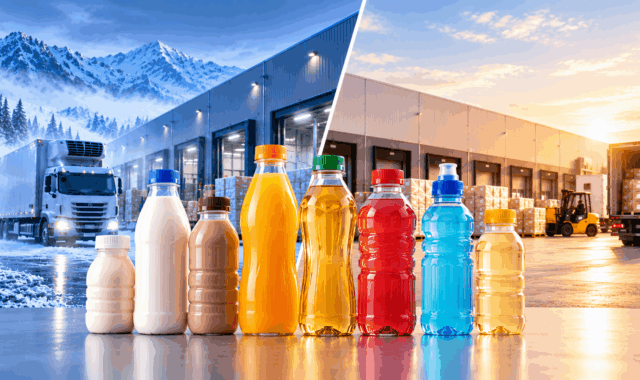
In the food industry, temperature control is a major challenge for product quality, operating costs, and logistics performance. Refrigerated transport, cold storage, energy consumption, and the risk of cold chain breaches all impact manufacturers’ profitability.
For certain liquid foods, packaging that allows for storage at ambient temperature offers a strategic alternative. By combining appropriate product processing, aseptic filling, and protective packaging, manufacturers can pursue distribution without refrigeration while maintaining the safety and quality of their products.
From milk to UHT whipped cream, mastery of the aseptic process is essential for packaging dairy products distributed outside the cold chain.
The cold chain requires maintaining controlled temperatures during the storage, transport, and distribution of the relevant food products. This requirement involves the use of cold storage rooms, refrigerated vehicles, and temperature monitoring and management systems. Any breach can compromise food safety and result in product losses.
For manufacturers seeking to expand their exports or serve markets with limited refrigeration infrastructure, these constraints can hinder business growth. For certain liquid foods, particularly UHT milk and some long-life beverages, the combination of appropriate processing, aseptic filling, and suitable packaging allows for storage at ambient temperature prior to opening, subject to validation of the entire process.
For iced teas, syrups, or long-life juices, explore examples of filling and capping beverages at ambient temperature.
| Criterion | Cold Chain | Ambient Temperature |
|---|---|---|
| Energy | Refrigeration required | No continuous refrigeration during transport and storage for suitable products |
| Warehousing | Refrigerated facilities | Suitable conventional warehouses |
| Risks | Temperature excursions | Other storage requirements still apply |
| Distribution | Refrigerated network required | Easier access to ambient distribution networks |
| Environment | Energy used for refrigeration | Potential benefits to be assessed over the full life cycle |
| Investment | Refrigeration equipment | Specialized processing and packaging |
These benefits are not automatic: they depend on the product, processing method, packaging, and distribution channels. The economic benefits must be assessed across the entire value chain.
Filling accuracy contributes to consistency in packaging but does not, by itself, guarantee microbiological safety. Microbiological safety depends on the entire process.
To increase your production rates and integrate these high-barrier processes, rely on our expertise to optimize your industrial production facilities.
The performance of an agri-food supply chain begins before transportation. Serac works with manufacturers to design filling and capping solutions tailored to their products, packaging, and shelf-life objectives.
For aseptic applications, controlling decontamination, filling, and sealing helps preserve the microbiological characteristics achieved during product processing. Serac’s solutions address the challenges of precision, hygiene, integrated capping, and format flexibility.
Serac can also support the evolution of existing facilities through audits, optimizations, and upgrades, depending on the technical capabilities of each production line.
“ Storage at ambient temperature depends on complete control over the product and its packaging: processing, aseptic filling, and guaranteed packaging integrity. Together, these factors prevent recontamination and allow products to be stored without refrigeration before opening, under the specified conditions. The reliability of the packaging thus becomes the key to eliminating the need for the cold chain after production. “
Microbiological safety during storage depends first and foremost on impeccable hygiene during the filling and capping of liquids.
UHT milk and dairy beverages
After appropriate UHT treatment, aseptic filling can allow for storage at room temperature before opening, subject to validation of the entire process.
Juices and long-life beverages
Depending on their formulation, certain beverages can be packaged for ambient distribution. The choice of process depends in particular on their acidity and shelf-life objectives.
Sauces and liquid preparations
Certain sauces can be stable at room temperature depending on their pH, formulation, processing, and packaging. The technology must be selected on a case-by-case basis.
A properly processed product can be placed in decontaminated or sterilized packaging, with recontamination controlled until the package is sealed. Ambient temperature storage depends on the validation of the entire process; it is not automatic.
The choice depends on the product’s sensitivity to oxygen, light, moisture, and temperature. Barrier properties, sealing, and compatibility with the process are critical factors.
Ambient temperature distribution can reduce refrigeration costs and simplify certain distribution channels, but sometimes requires investments in processing and packaging. Overall costs must be compared.
ESL extends shelf life, typically under refrigeration for the dairy products in question. An aseptic process combined with appropriate treatment can enable ambient temperature storage.
Analyze the product, processing, packaging, production rate, decontamination, sealing, shelf life, and distribution conditions before selecting a solution.
For products that are suitable, distribution at ambient temperature can reduce reliance on refrigeration, streamline supply chains, and open up new business opportunities. This transformation begins at the factory: the manufacturing process, filling, and packaging determine the possible storage conditions.
Are you considering a long-shelf-life packaging project?
Contact the Serac teams to analyze your product, packaging, production rate, and distribution requirements.
To stay ahead of trends in sustainable and barrier packaging, explore the most significant technological advancements in food packaging by 2025.
Learn how the Malo dairy is acquiring a new high-speed packaging line to meet its distribution challenges.