Sauces

The New Reality of Sauce Manufacturing

Walk into any supermarket today and spend a few minutes in the condiments aisle.
Ten or fifteen years ago, consumers generally had a straightforward choice. Today, the landscape looks completely different.

The Era of Standardized Production Is Over

Walk into any supermarket today and spend a few minutes in the condiments aisle.

Ten or fifteen years ago, consumers generally had a straightforward choice. They could select between one or two ketchup brands, a handful of mayonnaise products and perhaps a limited range of barbecue sauces or salad dressings. Product differentiation existed, but it remained relatively modest. Manufacturers could produce long manufacturing campaigns of a small number of recipes, using standardized packaging formats and predictable production schedules. Today, the landscape looks completely different.

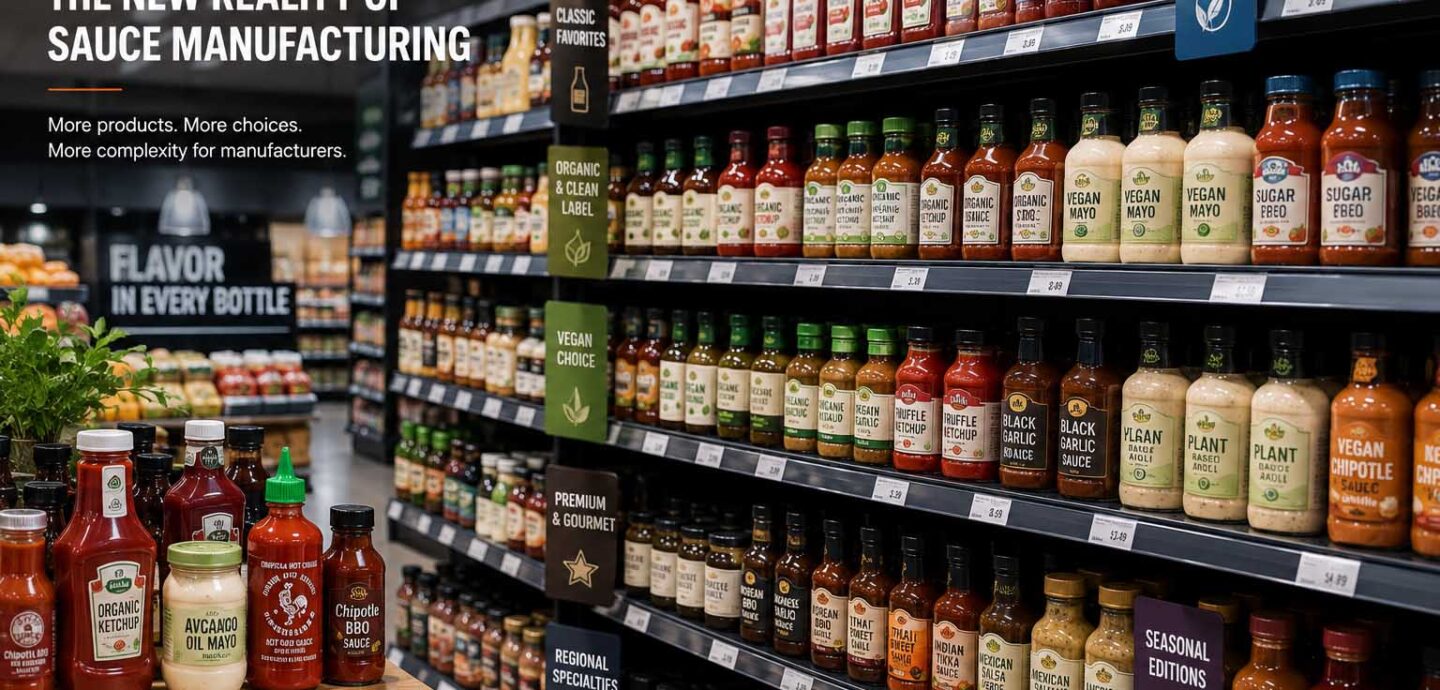
Consumers are confronted with an extraordinary variety of products. Alongside traditional ketchup and mayonnaise, supermarket shelves now offer organic recipes, reduced-sugar alternatives, premium gourmet sauces, regional specialties, vegan mayonnaise, spicy sriracha sauces, Korean barbecue marinades, chipotle dressings, truffle aioli, plant-based pestos, hummus variations, ethnic cooking sauces and countless limited-edition products designed for specific retail promotions or seasonal events. This transformation has fundamentally changed the economics of sauce manufacturing.

Success is no longer determined solely by a manufacturer’s ability to produce large volumes at low cost. Increasingly, competitive advantage depends on the ability to introduce new products rapidly, manage growing product portfolios efficiently and satisfy constantly evolving consumer expectations without compromising operational performance.

For manufacturing organizations, this represents one of the most significant industrial transformations of the past two decades.

Flexibility & SKU Expansion in Sauce Manufacturing
The New Reality of Sauce Manufacturing

Key Takeaways
1 The sauce industry has entered an era where product variety is becoming as important as production volume.
2 Consumer expectations, retailer requirements and global market dynamics continue driving rapid SKU expansion across virtually every sauce category.
3 While this diversification creates valuable commercial opportunities, it also introduces significant operational complexity.
4 Manufacturers that continue relying on production systems designed for long, repetitive manufacturing campaigns will find it increasingly difficult to remain competitive.

Consumers Have Changed Faster Than Factories

The rapid diversification of the sauce market has been driven primarily by changing consumer behaviour. Modern consumers rarely purchase food products solely on price. They increasingly evaluate products according to nutritional value, ingredient quality, sustainability, authenticity, convenience and personal lifestyle preferences.

  • Health-conscious consumers look for products with fewer additives and less sugar.
  • Environmentally conscious shoppers expect recyclable packaging and responsibly sourced ingredients
  • Food enthusiasts search for authentic regional flavours inspired by cuisines from around the world
  • Younger consumers are eager to discover limited editions, spicy recipes and premium experiences.


At the same time, retailers continue expanding their private-label portfolios, requiring manufacturers to develop exclusive recipes and customized packaging for individual supermarket chains. The result is a market where innovation never stops.

Unlike many industrial sectors where products remain stable for years, the sauce industry constantly renews itself. New flavours appear every season. Existing recipes are reformulated. Packaging formats evolve. Marketing campaigns generate temporary product launches. Export markets require country-specific packaging and labelling.

For manufacturers, this means that production environments are becoming progressively more dynamic.

Factories designed to produce ten or twenty products are now expected to manufacture one hundred or even several hundred Stock Keeping Units (SKUs), each with its own production requirements.

SKU Proliferation Has Become the New Industrial Reality

The term SKU proliferation has become increasingly common in manufacturing discussions, yet its operational consequences are often underestimated.

An SKU is far more than a commercial reference. Within a factory, every SKU represents a unique combination of technical parameters that production teams must manage successfully. A single change in bottle size may require different filling parameters. A different cap may require torque adjustments. A change in recipe may influence viscosity, product temperature, foaming behaviour or cleaning procedures. Changing from a smooth tomato ketchup to a pesto containing herbs and particulates is not merely a commercial variation; it is an entirely different production process. Consequently, the number of SKUs has become a useful indicator of manufacturing complexity.

It is no longer unusual for medium-sized sauce manufacturers to manage portfolios exceeding one hundred active SKUs. Large multinational producers may operate several hundred references across multiple production sites, serving retail, foodservice and export markets simultaneously.

What appears to consumers as product diversity becomes, for manufacturers, an increasingly sophisticated exercise in production planning, quality management and operational flexibility.

Flexibility Has Become a Competitive Advantage

Historically, production efficiency was measured primarily through output.

  • How many bottles could be produced each hour?
  • How many jars left the filling line every minute?


Maximum speed became the principal benchmark against which equipment was evaluated. While throughput remains important, it no longer provides a complete picture of manufacturing performance.

Imagine two production lines.

  • The first is capable of filling twenty-four thousand bottles every hour but requires ninety minutes to change from one product to another.
  • The second operates at slightly lower speed but completes product transitions in less than thirty minutes.


For a manufacturer producing only one recipe, the faster line may deliver greater annual output. For a manufacturer producing one hundred different sauces every year, the opposite is often true. The second production line spends considerably more time manufacturing saleable products because far less production time is lost during changeovers. This example illustrates an increasingly important principle.

Manufacturing performance should not be measured solely by production speed. It should be measured by productive time. The most successful factories are not necessarily those that produce the highest hourly output. They are those that maximize productive hours throughout the entire year.

Flexibility Is About Much More Than Bottle Sizes

The concept of flexibility is frequently misunderstood. Many manufacturers associate flexibility exclusively with packaging.

  • Can the equipment process both PET and glass bottles?
  • Can it accommodate different bottle heights?
  • Can operators switch between cap formats?


These questions are certainly relevant, but they represent only one dimension of manufacturing flexibility. True flexibility encompasses every aspect of production.

It involves the ability to move rapidly between recipes with different viscosities, ingredients and particulate content. It requires equipment capable of maintaining filling accuracy despite significant variations in product behaviour. It demands production systems that simplify cleaning, automate machine adjustments and reduce dependency on operator experience.

Equally important, flexibility extends beyond the production line itself. Planning systems, recipe management, inventory control and quality assurance all contribute to a manufacturer’s ability to respond quickly to market opportunities. When viewed from this broader perspective, flexibility becomes much more than an equipment characteristic.

It becomes an organisational capability.

How many active SKUs does your factory manage today?

Let’s start the conversation 

Frequently Asked Questions

What is driving the increase in sauce product variety?

Several factors are contributing to the rapid expansion of sauce portfolios. Consumers increasingly expect healthier ingredients, authentic regional flavours, plant-based alternatives, premium recipes and seasonal innovations. At the same time, retailers are expanding private-label ranges, while export markets require country-specific recipes, packaging and labelling. Together, these trends force manufacturers to produce a much wider variety of products than in the past.

What does SKU proliferation mean in sauce manufacturing?

SKU proliferation refers to the continuous increase in the number of Stock Keeping Units (SKUs) that a manufacturer produces. In sauce manufacturing, each SKU often requires unique recipes, packaging formats, filling parameters, cleaning procedures and quality controls. As the number of SKUs grows, production planning and factory operations become significantly more complex.

Why is SKU proliferation a challenge for food manufacturers?

Every additional SKU introduces operational complexity. Manufacturers must perform more product changeovers, manage larger inventories, validate more recipes and maintain consistent quality across a wider range of products. Without flexible production systems, SKU proliferation can reduce efficiency and increase manufacturing costs.

Why is manufacturing flexibility becoming more important than production speed?

High production speed only creates value when equipment is producing saleable products. In modern sauce factories, frequent product changes often result in downtime for cleaning, machine adjustments and quality checks. Flexible production systems that minimise changeover time can achieve higher annual productivity than faster machines with long setup times.

The following articles may interest you