

Producing Multiple Sauces in One Day: How Manufacturers Reduce Cleaning Time?
Learn how to sequence multiple sauce recipes, reduce intermediate cleaning, and increase the productive availability of your filling line.
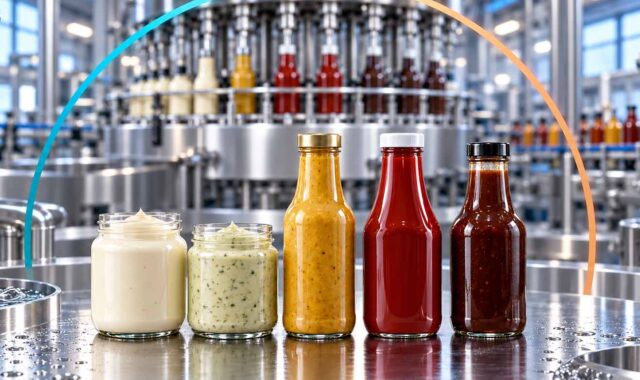
To keep pace with the growing number of SKUs, shorter production runs, and promotional demand, sauce manufacturers increasingly need to produce multiple recipes on the same packaging line.
In a single day, a facility may need to fill:
This variety creates valuable business opportunities. However, it also presents a major production challenge:
How can manufacturers switch from one recipe to another without multiplying full cleaning cycles and production downtime?
Cleaning remains essential to food safety. However, not every product changeover necessarily requires the same level of cleaning. Smart production scheduling can make it possible to run certain compatible recipes consecutively, while reserving full cleaning cycles for transitions that truly require them.
The general rule is to organize production from the least impactful product to the most impactful, taking four main criteria into account: color, flavor, texture, and allergens.
However, this production sequence must always be incorporated into the facility’s food safety plan and approved by its quality team.
Producing Multiple Sauces in One Day: How Can You Reduce Cleaning Time?
| Key Takeaways | |
| 1 | The right production sequence can reduce the number of intermediate cleaning cycles and increase the time actually spent filling products. |
| 2 | Sauces should be classified according to their color, flavor intensity, texture, particulates, and allergen profile. |
| 3 | The general “least impactful to most impactful” rule must always remain subordinate to food safety requirements. |
| 4 | A compatibility matrix can define which transitions are permitted, which require rinsing, and which require a full cleaning cycle. |
| 5 | Hygienic filler design, digital recipe management, and automated cleaning cycles can reinforce the benefits achieved through production scheduling. |
When a facility produces the same recipe for several days, a full cleaning cycle at the end of the production campaign represents a relatively small share of total production time.
The situation changes when five, six, or ten recipes must be filled on the same day. Each transition may then involve:
Individually, each stoppage may appear manageable. However, their cumulative impact can quickly reduce line availability and overall equipment effectiveness, or OEE.
The cost is not limited to downtime. It also includes:
The manufacturer’s objective is therefore not to eliminate cleaning, but to determine when a full cleaning cycle is essential and when a simplified transition can be authorized.
To limit cleaning between production runs, the general approach is to begin with sauces that have the lowest potential impact on the products that follow.
A light-colored, mild, fluid sauce without particulates will generally be scheduled before a dark, spicy, thick sauce or one containing chunks.
The reverse sequence is much more difficult to control. Even small traces of dark barbecue sauce can alter the appearance of white mayonnaise. A small amount of spicy sauce may affect the flavor of a mild recipe. Herb particles can also become visible in an otherwise perfectly smooth product.
The objective is to create a logical progression based on several criteria.
Color is often the easiest criterion to assess.
For example, a production sequence could progress as follows:
Producing a light-colored sauce after a highly pigmented product increases the risk of visible carryover. Even a very small amount of residue can affect the appearance of the next product.
Moving from light to dark can therefore simplify certain transitions. However, color alone is not enough: two products with similar colors may have incompatible flavors, textures, or allergen profiles.
Strongly flavored ingredients can have a significant impact, even at low concentrations.
Sauces containing ingredients such as:
are generally scheduled toward the end of a production campaign or immediately before a full cleaning cycle.
A plain sauce will therefore often be produced before a spicy variation made from a similar base.
This approach can be particularly useful for a family of products that share the same base recipe. For example, classic mayonnaise may be followed by herb mayonnaise and then a spicy version, provided this sequence has been assessed and approved.
Viscosity and particulates also influence the ideal production order. Very thick products or sauces containing chunks can leave more residue in:
A possible production sequence would be:
This logic should not be applied mechanically. A fluid sauce with a strong pigment or a critical allergen may need to be placed elsewhere in the schedule.
The actual behavior of the product during filling must also be considered, including its flow characteristics, air retention, stringing, dripping, surface adhesion, and sensitivity to shear.
Allergens are the highest-priority criterion.
A common approach is to produce recipes that do not contain a specific allergen first, followed by products that do. This can prevent the need to return later to a product in which that allergen must not be present.
However, production sequencing never replaces a validated cleaning process when a transition presents a risk of allergen cross-contact.
Production planning must account for the allergens present in each recipe, which may include:
In some cases, the best approach is to group recipes that share the same allergen profile. In others, physical separation, a dedicated production campaign, or a fully validated cleaning cycle may be required.
All decisions must be defined within the manufacturer’s HACCP program and quality procedures.
To turn this general rule into a practical planning tool, manufacturers can group recipes into compatibility families.
For example, the following families could be created:
Each product can then be classified according to several criteria:
| Criterion | Examples of information |
|---|---|
| Color | White, yellow, red, green, brown |
| Flavor intensity | Mild, aromatic, spicy, smoked |
| Viscosity | Fluid, medium, thick, very thick |
| Particulates | None, fine, fibrous, chunks |
| Allergens | Egg, milk, mustard, soy, sesame, etc. |
| Microbiological requirements | Acidic, sensitive, refrigerated, etc. |
| Cleaning requirement | Direct transition, rinse, full cleaning |
This classification can be used to build a changeover matrix. For every transition from Recipe A to Recipe B, the matrix can specify:
The decision no longer depends solely on an operator’s experience. It becomes standardized, traceable, and repeatable.
Consider a manufacturer that needs to fill six sauces on the same line:
A logical production sequence could be:
This sequence generally progresses:
However, this sequence can only be approved after checking allergen profiles, microbiological compatibility, labeling requirements, and the applicable cleaning procedures.
The ideal schedule therefore does not depend on a single criterion. It results from balancing food safety, product quality, and production performance.
Even with optimized scheduling, some transitions still require a full cleaning cycle.
This is particularly true when:
The “least impactful to most impactful” rule is therefore an optimization tool. It must not be interpreted as general authorization to eliminate intermediate cleaning cycles.
Production scheduling can only deliver its full benefits if the packaging line has been designed to facilitate recipe changeovers.
The product circuit should minimize:
A properly drainable circuit makes it easier to remove the remaining product and improves the repeatability of cleaning cycles.
Mayonnaise, ketchup, fluid sauces, and products containing particulates do not behave in the same way during draining and cleaning.
Filler design must therefore consider:
The objective is to minimize product losses while ensuring effective cleaning.
Depending on the filler configuration, a cleaning manifold can collect the fluids circulating through the filling nozzles during the cleaning cycle.
This configuration can help automate certain operations and reduce the manual handling required around the machine. It can also improve cleaning-cycle repeatability, provided that the complete installation is designed around the manufacturer’s cleaning process.
Certain line configurations allow part of the changeover process to be completed while another operation is still underway.
During the end of a batch or while preparing the next one, operators may be able to:
The goal is to move as many tasks as possible outside the actual line-stoppage period. This approach reflects SMED principles applied to recipe changeovers.
The settings associated with each sauce can be saved in the machine interface, including:
Instead of manually rebuilding all the settings, the operator selects the appropriate recipe. This automation reduces the risk of error and accelerates line restart after a product changeover.
The effectiveness of a new production-sequencing strategy must be measured.
Key performance indicators may include:
These data points enable manufacturers to compare different production scenarios and identify the most time-consuming or costly transitions.
They may also reveal that investing in cleaning automation, modifying the product circuit, or implementing digital recipe management could deliver a rapid return on investment.
Producing multiple sauces in a single day does not necessarily have to result in more full cleaning cycles.
By classifying products according to color, flavor intensity, texture, particulates, and allergens, manufacturers can create more consistent production campaigns. This can reduce certain stoppages, product losses, and cleaning-related resource consumption.
However, performance does not depend on production scheduling alone. It also relies on product-circuit design, drainability, cleaning automation, and the filler’s ability to recall the correct settings quickly.
As discussed in Serac’s article on agile sauce production lines, flexibility and hygienic design should be considered from the earliest stages of line development.
Optimize Recipe Changeovers on Your Sauce Line
Does your facility need to package more recipes in shorter production runs without compromising food safety or product quality?
Serac designs filling and capping solutions for different viscosities, products containing particulates, and frequent production changeovers. Our teams analyze your recipes, packaging formats, production sequences, and cleaning procedures to define a solution adapted to your specific production requirements.
Contact our experts to explore how you can reduce nonproductive time
between sauce production campaigns.
FAQ
In What Order Should Multiple Sauces Be Produced on the Same Line?
The general rule is to progress from the least impactful product to the most impactful: light to dark, mild to spicy, and smooth to particulate-rich. However, allergen and microbiological risks always take priority over this general sequencing principle.
Can Manufacturers Change Sauces Without Performing a Full Cleaning Cycle?
This may be possible between certain compatible recipes if the transition has been evaluated, documented, and approved by the quality team. Depending on the products, purging or rinsing may be sufficient. Transitions involving allergen, microbiological, or quality risks require an appropriate validated procedure.
How Can Manufacturers Determine Whether Two Sauces Are Compatible?
Their color, flavor, viscosity, particulates, allergens, microbiological sensitivity, and storage requirements must be compared. A changeover matrix can then formalize the level of cleaning required between each pair of recipes.
How Can Sauce-Filler Cleaning Time Be Reduced?
Cleaning time can be reduced through several complementary measures: a product circuit designed to minimize retention zones, good drainability, automated cleaning sequences, an appropriate cleaning manifold, and the preparation of certain changeover tasks while production is still running.
Can Production Sequencing Reduce Water Consumption?
Yes. When production sequencing helps avoid unnecessary full cleaning cycles between compatible recipes, it can reduce water consumption. Actual savings will depend on the products, process, line configuration, and the manufacturer’s validated food safety procedures.