

Your Sauce Is Premium But Will It Still Be Premium at 18,000 Bottles per Hour?
Learn how to scale a premium sauce to 18,000 bottles per hour while protecting texture, particulates, filling accuracy, hygiene, and profitability.
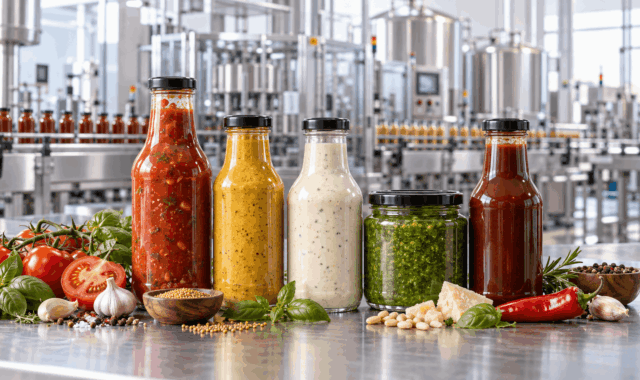
A sauce can be exceptional when it is produced in a small development kitchen. But what happens when the same recipe must be pumped, transferred, dosed, and filled at up to 18,000 bottles per hour?
At that speed, 5 containers are filled every second. Small variations in temperature, viscosity, ingredient distribution, or filling parameters can quickly become visible across thousands of bottles.
For sauce manufacturers, the real scale-up challenge is therefore not simply producing more sauce. It is preserving the characteristics that make the product premium: its texture, appearance, taste, ingredient integrity, fill consistency, and overall consumer experience
Your Sauce Is Premium But Will It Still Be Premium at 18,000 Bottles per Hour?
| Key takeaways | |
| 1 | A successful laboratory recipe is not automatically ready for industrial filling |
| 2 | Viscosity alone does not fully describe how a sauce will behave in pipes, pumps, valves, and filling nozzles. |
| 3 | Herbs, seeds, spices, and vegetable pieces require careful management to prevent damage and inconsistent distribution. |
| 4 | Product temperature can affect flow behavior, filling performance, foaming, and dosing repeatability. |
| 5 | Filling accuracy becomes financially critical when sauces contain expensive premium ingredients. |
| 6 | Hygienic equipment design and effective cleaning must be considered from the beginning of the project. |
| 7 | Testing the real recipe in the real container remains one of the safest ways to validate a filling solution. |
A premium sauce is often defined by the very characteristics that make it challenging to process.
It may contain:
During small-batch production, a sauce may be mixed gently, transferred manually and filled at a relatively low speed. Industrial production introduces very different conditions.
The product may travel through tanks, pumps, elbows, pipes, manifolds, and filling valves. It may be exposed to pressure, acceleration, temperature changes, and mechanical shear. It must then be divided into thousands of consistent portions.
The central question is straightforward:
Can the industrial process preserve the product attributes that persuaded consumers to pay a premium price?
Viscosity is important, but a single viscosity value rarely tells the entire story. Many sauces are non-Newtonian fluids. This means their apparent viscosity changes according to the force applied to them. A sauce can appear thick while stationary but become significantly easier to pump or dose when it is agitated or subjected to shear.
Manufacturers should therefore look beyond a single measurement and consider the product’s complete rheological behavior, including:
Rheological measurements are valuable because they can reproduce conditions associated with agitation, pumping, pipe flow, and dispensing. This provides more relevant information than evaluating the sauce only when it is stationary.
Two sauces with a similar viscosity measurement may therefore behave very differently on the same filling machine. One may flow cleanly through the filling nozzle. The other may create long strings, trap air, splash into the container neck, or continue dripping after the valve closes.
Visible ingredients contribute strongly to the premium perception of a sauce. They also create an important production challenge: every container should receive a representative quantity of both the liquid base and the solid inclusions.
Several problems can occur during industrial processing:
The filling system should consequently be evaluated according to the sauce’s maximum particle size, particle shape, concentration, and fragility.
Gentle agitation may help maintain ingredient distribution in the supply tank. However, agitation must be controlled: too little can allow separation, while too much can damage delicate inclusions or incorporate air.
The product path is equally important. Pumps, pipes, bends, manifolds and filling valves must provide sufficient passage for the ingredients without creating unnecessary mechanical stress.
The objective is not simply to prevent blockages. It is to ensure that the consumer sees the same generous, recognizable ingredients in every bottle.
Temperature can influence several characteristics simultaneously:
A sauce filled at 20°C may behave differently from the same sauce filled at 60°C or 85°C. Even smaller temperature variations between the beginning and end of a production batch can affect filling performance.
For this reason, the target filling temperature and its acceptable operating range should be defined before final machine settings are validated.
Temperature should not be treated as a secondary detail supplied after the filling equipment has been selected. It is an essential part of the product specification
It can if the complete process is not adapted to the formulation.
Mayonnaise style sauces, creamy dressings and oil in water emulsions depend on a controlled structure. Pumps, recirculation loops, restrictions, and pressure changes may influence that structure.
The risk depends on factors such as:
The filling machine is only one element of the process. A valve designed for gentle dosing cannot fully compensate for product damage that has already occurred upstream.
That is why scale-up trials should reproduce as much of the intended process as possible not only the final movement of the filling nozzle.
Premium ingredients make every extra gram more expensive. Consider a line producing 18,000 bottles per hour. If each bottle receives just one unnecessary gram of product, the line gives away:
This is an illustrative calculation, but it shows how a seemingly negligible difference can become a significant annual cost.
Manufacturers typically add a safety margin above the declared quantity to reduce the risk of underfilled containers. The more variable the filling process is, the larger that safety margin may need to be.
Improving repeatability can allow the average fill target to be positioned closer to the declared quantity while still complying with applicable net-content rules.
In the United States, the National Institute of Standards and Technology publishes Handbook 133 for checking the net contents of packaged goods. In the European Union, Directive 76/211/EEC establishes rules for nominal quantities and tolerable negative errors in certain prepackages.
The appropriate filling technology depends on the product, container, production rate, and regulatory environment. Weight filling offers an important advantage: the quantity delivered is measured as mass during the filling cycle.
This can be particularly relevant for sauces whose density may vary because of temperature, formulation, or ingredient distribution.
There is no universal answer. Both technologies can be appropriate when correctly matched to the application.
Weight filling may be particularly suitable when:
Volumetric filling may be suitable when:
The decision should be based on actual product trials rather than on sauce category alone. A smooth ketchup, a vegan mayonnaise, a pesto containing visible solids, and a chunky tomato sauce do not create the same filling conditions.
A realistic filling trial should evaluate more than whether the machine can place sauce into a bottle.
The following parameters should be documented:
During the trial, manufacturers should inspect:
A short test at reduced speed may not reveal what happens during a complete industrial run. Trials should reproduce the target production conditions as closely as reasonably possible.
Before investing in a filling line, sauce manufacturers should ask:
These questions help move the discussion beyond nominal machine speed. The best filling solution is not necessarily the one with the highest theoretical output. It is the one that can repeatedly achieve the required output while protecting product quality, hygiene, and profitability.
At 18,000 bottles per hour, quality is no longer defined by a single perfect bottle. It is defined by the manufacturer’s ability to produce bottle number 18,000 with the same texture, ingredient distribution, appearance, and fill quantity as bottle number one.
That level of consistency requires the recipe, process, filling technology, container, and cleaning strategy to be considered as one complete system.
Serac works with sauce manufacturers to evaluate their products, packaging formats, production objectives, and filling constraints. Testing with the actual sauce and container can help identify the right filling principle, product path, valve configuration, and operating parameters before industrial production begins.
Contact us to discuss your product and conduct filling tests under conditions representative of your production objectives.
The best technology depends on the sauce’s rheology, temperature, particulates, foaming behavior, target quantity, and container. Weight and volumetric filling can both be appropriate, but the selection should be confirmed through tests with the actual product.
Yes, provided that the complete product path—including the pump, pipes, manifolds, and valves is sized for the maximum particle dimensions and designed to limit blockages and ingredient damage.
Weight filling measures the mass delivered into each container. It can help control product giveaway and maintain fill accuracy when density varies, particularly for products sold by net weight.
Temperature can change viscosity, density, foaming, dripping, and emulsion behavior. The filling temperature and its acceptable variation should therefore be defined and controlled during production.
Dripping can be reduced through appropriate valve design, nozzle configuration, closing parameters, product pressure, temperature control, and correct characterization of the sauce’s flow behavior.
Yes. Testing the real product in the intended container helps verify filling accuracy, particle integrity, nozzle cleanliness, foam behavior, production speed, and cleaning requirements.